TL;DR
How do I get my business to show up on the first page of Google? Follow these 10 steps:
- Find out where you currently stand. Check whether your website is indexed, ranking, or missing from local results.
- Choose the searches that matter. Focus on keywords your potential customers actually use to find your products or services.
- Match search intent. Create pages that directly satisfy what people are looking for, not pages that simply repeat keywords.
- Fix your technical SEO foundation. Make sure Google can crawl, understand, and index your important pages.
- Build clear service and product pages. Give each important offering a focused, useful page instead of trying to rank one page for everything.
- Create supporting content. Answer the questions your customers ask and build topical relevance around your core services.
- Strengthen your internal linking. Connect related pages so users and search engines can understand how your content fits together.
- Build authority beyond your website. Earn relevant links, mentions, reviews, PR coverage, and other credible third-party signals.
- If you’re a local business, optimize local SEO. Improve your Google Business Profile, reviews, services, and local relevance.
- Measure and improve what happens after ranking. Track impressions, clicks, leads, conversions, and revenue, not just your position on Google.
The key is to diagnose the problem before choosing the tactic. If you’re not indexed, more blog posts won’t fix it. If you’re ranking but getting no enquiries, more SEO may not be the answer. Find the bottleneck, fix it, then build from there.
Why “Page One” Is Actually Two Different Problems

When you search for something like “how do I get my business to show up on the first page of Google?”, you’re usually talking about one of two things.
The first is organic search visibility. These are the regular website results that appear on Google’s search results page.
The second is local search visibility, particularly the map pack that can appear when someone searches for a local business or service.
These overlap, but they are not the same thing.
A business can rank well organically and still have weak local visibility. Another business might appear in the map pack while its website barely ranks for relevant organic searches.
That distinction matters because the fix depends on the problem.
So before you start changing your website, publishing blog posts, or paying for SEO, ask a simpler question:
Where am I currently invisible?
Step 1: Find Out Why Your Business Isn’t Showing Up
Before trying to get to page one, establish where you are starting.
There are several possibilities.
1. Your website isn’t indexed
If Google hasn’t indexed an important page, that page cannot rank for its target searches.
This is fundamentally different from having a page that ranks on page five.
If nothing from your website appears for relevant searches, check whether the important pages are actually indexed and whether technical problems are preventing Google from crawling or understanding them.
According to Google’s own documentation on how Search works, indexing isn’t guaranteed even once a page is found, common blockers include robots rules disallowing indexing, or a site structure that makes crawling difficult.
2. Your website is indexed but buried
Your page exists in Google’s index, but competitors occupy the positions you want.
This is usually where relevance, content quality, topical authority, technical health, and search intent become important.
3. Your website ranks, but your local business doesn’t appear in the map pack
This is a different problem.
Your website could rank organically while your Google Business Profile has poor local visibility.
4. You’re appearing inconsistently
You might appear for some searches but disappear for others.
This can happen because local search results vary based on the searcher’s location and the specific query. It can also indicate that your business does not have enough relevance or prominence for the searches you’re targeting.
5. You’re ranking, but nobody is contacting you
This is the one businesses often overlook.
If you’re already receiving impressions and clicks but few enquiries, getting from position 8 to position 4 may not be your biggest problem.
Your page might have a relevance, trust or conversion problem instead.
Step 2: Decide Which Searches You Actually Want to Rank For
Getting onto page one for something isn’t the goal.
Getting onto page one for searches that can contribute to your business is.
Start by identifying the products, services and problems that matter commercially.
For example, a dental clinic might want visibility for searches such as:
- dentist in Lagos
- dental clinic in Lagos
- teeth whitening Lagos
- dental implants Lagos
- emergency dentist Lagos
A real estate agent might have a different set of searches:
- real estate agent in Toronto
- homes for sale in Toronto
- condos for sale in Toronto
- Toronto real estate agent
- homes for sale in North York
The important point is that you shouldn’t begin with “How do I rank my website?”
Begin with:
“What searches do I need to be visible for?”
That gives your SEO strategy something concrete to work toward.
Step 3: Match Your Page to What the Searcher Wants
Once you’ve identified a valuable search, look at the pages currently ranking.
What are they actually providing?
A person searching for:
“How much does SEO cost for a small business in Nigeria?”
probably wants pricing information, factors that affect cost and perhaps examples.
Someone searching:
“SEO agency in Lagos”
is much more likely looking for businesses they could hire.
Those are different search intents, even though both contain the word “SEO.”
Your page needs to satisfy the underlying need behind the search.
That means you shouldn’t simply repeat the keyword throughout the page.
Instead, ask:
- What is the searcher trying to accomplish?
- What information do they need?
- What questions are they likely to have next?
- What would make them trust this page?
- What is missing from the pages currently ranking?
- What would make this page more useful than the alternatives?
That is a much stronger starting point than keyword density.
Step 4: Make Sure Google Can Crawl and Understand Your Website
Before investing heavily in content, make sure your technical foundation isn’t working against you.
At a basic level, check:
- Important pages are indexable.
- Your site doesn’t have unnecessary crawl or indexing restrictions.
- Important pages can be reached through internal links.
- Your website has a logical structure.
- Page titles and headings clearly describe the content.
- Your pages load reasonably well.
- Your website works properly on mobile devices.
- Duplicate or competing pages aren’t confusing your targeting.
- Your important commercial pages aren’t buried several clicks deep.
You don’t need a technically complicated website to rank.
But you do need a website that search engines can access, understand and connect to the searches you’re targeting.
Step 5: Build the Right Page for Each Important Service
One mistake businesses make is trying to make their homepage rank for everything.
A better approach is usually to create clear, useful pages around your core commercial offerings.
For example, an agency offering SEO, email marketing and paid advertising shouldn’t necessarily try to rank one homepage for every service.
A clearer structure might include:
- SEO services
- Local SEO services
- Technical SEO
- On-page SEO
- Email marketing
- Google Ads management
- Social media advertising
Each page can then focus on its own search intent and audience.
This doesn’t mean you need a separate page for every minor keyword variation.
It means you should give important topics enough space to be explained properly.
Step 6: Create Content That Supports Your Important Pages
This is where content marketing can help.
But here’s an important distinction:
You don’t need a blog simply because someone told you that businesses need blogs to rank.
You need useful content that helps you establish relevance, answer customer questions and support the topics that matter to your business.
For example, an SEO agency could publish articles covering:
- How much does SEO cost?
- How long does SEO take?
- Is SEO worth it for a small business?
- What is local SEO?
- How does Google Business Profile affect local SEO?
- How do you measure SEO results?
Those articles can then naturally connect to relevant service pages.
This creates a relationship between your informational content and your commercial pages.
The goal isn’t to publish as much as possible.
The goal is to build useful coverage around the subjects you actually want to be known for.
Step 7: Strengthen Your Internal Links
Internal linking is easy to overlook because it doesn’t feel as exciting as publishing a new article or earning a backlink.
But your internal links help search engines understand how the pages on your website relate to one another.
They also help users move from informational content toward relevant commercial pages.
For example, an article explaining how local SEO works could naturally link to your local SEO service page.
An article about technical SEO problems could link to your SEO audit service.
The important word is naturally.
Don’t add internal links simply to increase the number of links on a page. Use them where they genuinely help the reader continue their journey.
Step 8: Build Authority Beyond Your Website
Having a useful website isn’t always enough.
Google also has to determine how credible and relevant your business is compared with the other businesses competing for the same visibility.
This is where signals beyond your own website can become important.
Depending on your business, that could include:
- Relevant backlinks
- Industry publications
- Local business directories
- Professional associations
- Digital PR
- Industry mentions
- Partnerships
- Reviews
- Original research
- Case studies
- Genuine third-party references
This is particularly important in competitive markets.
If ten businesses all publish reasonably good content about the same subject, the question becomes:
Why should Google trust one of them more than another?
Your website needs to provide a reason.
Step 9: If You’re a Local Business, Optimize for Local Search Too
If customers need to find you in a particular city or service area, organic SEO is only part of the picture.
Your Google Business Profile deserves attention.
Start with the fundamentals:
Choose the correct primary category
Your primary category should accurately represent the business.
Don’t choose a category simply because you think it has more search visibility.
Complete your profile
Make sure important business information is accurate and consistent.
Add the services you actually provide and ensure they correspond with the information on your website.
Build genuine reviews
Reviews can contribute to the overall reputation and visibility of a local business.
But don’t treat reviews as a numbers game.
The objective is to build a genuine reputation from actual customers.
Keep the profile active
Relevant photos, updates and accurate information can help keep your business profile useful rather than leaving it looking abandoned.
Build local relevance
Your website and your broader online presence should make it clear what you do and where you actually operate.
However, there is one factor you cannot completely optimize away:
distance.
A business cannot simply create a page for a city and expect Google to treat it as physically located there.
Step 10: Don’t Ignore Conversion Once You Start Ranking
Here’s where the definition of success needs to expand.
Suppose you finally reach position three.
You receive 10,000 impressions and 500 website visits.
But nobody calls, submits a form or books a consultation.
Did your SEO succeed?
From a ranking perspective, yes.
From a business perspective, not necessarily.
That’s why page-one visibility should be connected to what happens after the click.
Check:
- Is the page relevant to the search?
- Is the offer clear?
- Is there an obvious next step?
- Can visitors quickly understand what you do?
- Do they have enough information to trust you?
- Is your contact process easy?
- Does the page work well on mobile?
- Are you tracking enquiries and conversions?
SEO can bring people to the website.
The website still has to give them a reason to act.
How Do You Rank on Page One Through Organic SEO?
Once you know you’re indexed, organic ranking comes down to matching what the searcher actually wants, better than the pages currently ranking.
Start with search intent, not just the keyword itself. A search for “best accountant for small business” wants a comparison or recommendation. A search for “how much does an accountant cost” wants a direct answer with real numbers. Matching that intent matters more than matching the exact words.
From there, the fundamentals are not exotic: a clear page for each core service, content that actually answers the question better than what’s currently ranking, reasonable page speed, and a site structure Google can crawl without difficulty.
If you’re trying to decide whether this is worth the investment of time it takes, our article on whether SEO is worth it for your business walks through the realistic timeline and what to expect.
How Do You Get Into the Local Map Pack?
The map pack runs on a different set of signals than organic ranking.
Your Google Business Profile category is the single factor most consistently tied to map pack ranking, according to BrightLocal’s Local Search Ranking Factors research. Choosing the correct primary category, one that accurately reflects what you actually do, matters more than almost anything else you can control.
Beyond category, the profile needs to be complete and active: an accurate service list, regular photos, posts published consistently rather than left dormant, and a steady flow of reviews that you actually respond to.
Distance to the searcher is the one major factor you cannot optimize directly. You can’t move your business, but you can make sure Google understands your full service area so you show up for searches from slightly further out.
What We Learned Fixing Visibility for a Medical Aesthetic Clinic

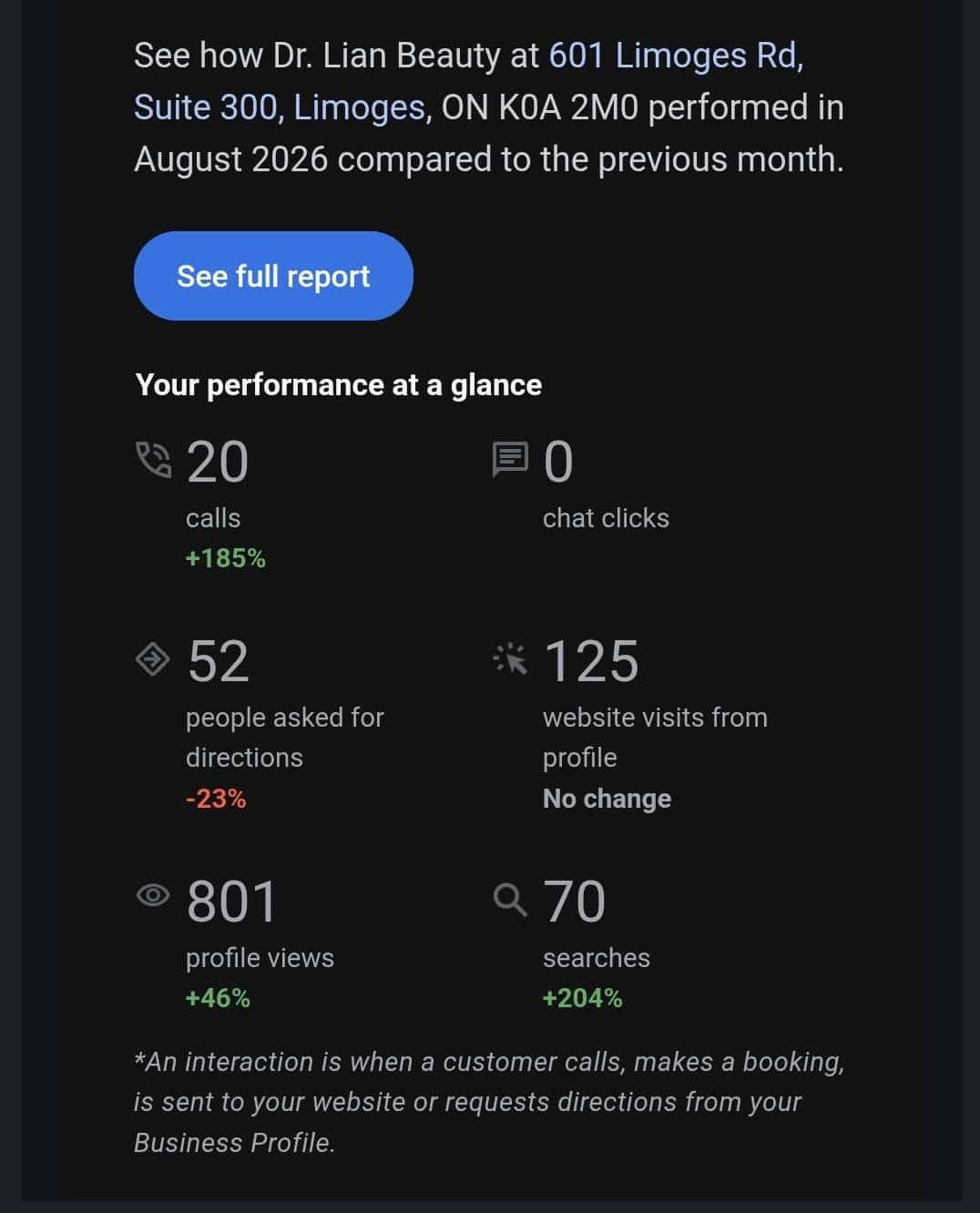
Some of what’s in the two sections above came directly out of a real project: a medical aesthetic clinic in Limoges, Ontario, where visibility was a problem on both fronts at once.
Before the work started, the clinic’s website wasn’t appearing organically at all for its core treatment terms. Not buried, not indexed in a useful way.
Its Google Business Profile wasn’t in much better shape. The category didn’t accurately reflect what the clinic specialized in, reviews had been declining, the service list hadn’t been updated to match what the clinic actually offered, and the profile had gone quiet, no regular posts or activity.
We tracked the local map pack (3-pack) appearance as its own separate metric from organic rankings, specifically because the two don’t move together. In this case, the improvement in local pack visibility came from the combination of the Google Business Profile fixes and the organic SEO work happening at the same time, closely enough that we can’t cleanly credit one over the other.
The practical lesson: if your business is invisible on both fronts, you likely need to work on both at once rather than picking one and hoping it carries the other.
Why More Blog Posts Alone Won’t Get You There
The most common misconception we see is that publishing more content, more blog posts, more articles, is the fix for not showing up on page one.
That instinct isn’t entirely wrong. Content that genuinely answers real questions your customers are asking does help you show up, especially for local businesses answering location-specific questions.
But it’s one tactic among several, and on its own it rarely moves a map pack ranking. The tactics that increasingly matter alongside it are digital PR, getting genuinely mentioned by other relevant, credible sites, and publishing original data or case studies rather than only restating what’s already been written elsewhere.
That shift matters even more now that AI-powered search features exist alongside traditional results. Google’s own guidance confirms the same foundational SEO practices remain relevant for AI Overviews and AI Mode, but original, citable content tends to have an edge in what gets pulled into those AI-generated answers.
In short: content is necessary, but it was never sufficient on its own, and treating it as the whole strategy is where a lot of businesses get stuck.
The FKD Page One Diagnostic
Use this to work out which problem you actually have before you spend on a fix for the wrong one.
| What you’re seeing | Likely blocker | Where to focus |
| Nothing of mine shows up at all, even on later pages | Indexing or crawlability problem | Technical SEO fundamentals |
| My site shows up, but only on page 3 or later | Relevance or content depth problem | Organic SEO |
| I rank organically, but I’m not in the map pack | Google Business Profile or proximity problem | Local SEO / GBP |
| I’m in the map pack sometimes, but inconsistently | Profile completeness or review activity problem | Local SEO / GBP |
| I rank, but searchers don’t click or contact me | Relevance or trust-signal mismatch, not a ranking problem | Content and conversion, not more SEO |
This isn’t a scoring system, it’s a starting point for a conversation about where your actual gap is.
How Long Does It Take to Get on the First Page of Google?
There is no fixed amount of time it takes to reach the first page of Google. Some pages can reach the top 10 within weeks, while others take many months or never get there at all.
Organic SEO typically takes three to six months to show measurable movement, longer in competitive markets, a timeline Ahrefs’ own research on SEO timelines and Search Engine Land’s guide both reflect.
In short, the timeline depends on the competitiveness of the search, your website’s existing strength, the quality and relevance of the page, and how much work is required to become competitive.
Local map pack improvements can move faster in some cases, since fixing an obviously wrong category or a dormant profile can produce visible change within weeks, but a genuinely competitive local market still takes months to move meaningfully.
In the Limoges project, visible movement on both fronts started showing up around the three-month mark, which lines up with what the research above describes as typical, not exceptional.
When Page One Isn’t the Right Goal Yet
Sometimes the answer isn’t “do more SEO.”
If your website has serious technical problems, fix those first.
If nobody searches for your service in your target market, ranking for it won’t create demand that doesn’t exist.
If your website receives traffic but doesn’t generate enquiries, improving conversion may produce more value than chasing another few ranking positions.
And if you’re targeting an extremely competitive search against businesses with substantially more authority, you may need a more realistic entry point.
That could mean targeting:
- More specific searches
- Location-based searches
- Commercial long-tail keywords
- Less competitive services
- Supporting informational searches
Then you can expand your search visibility as the website builds relevance and authority.
Final Takeaway
Getting your business on the first page of Google starts with knowing which first page you’re actually chasing, organic or local map pack, and which one you’re currently missing.
Check whether you’re indexed at all, diagnose which specific blocker applies to you, and work on that one before spending more on tactics aimed at a problem you don’t actually have.
If you want a clearer picture of where your own visibility gap is, talk to Florens Kairos Digitals.
Frequently Asked Questions
How long does it take to get on the first page of Google?
Organic SEO typically takes three to six months to show meaningful movement, longer in competitive markets. Local map pack changes can sometimes show up faster if the fix is a glaring profile issue, but genuine competition still takes months either way.
Why is my business not showing up on Google at all?
This usually means an indexing problem rather than a ranking problem. Your page may not have been crawled yet, or something on the site, like a robots rule or a difficult site structure, may be blocking it from being added to Google’s index in the first place.
Is Google Business Profile more important than my website for local search?
For the map pack specifically, yes, it tends to carry more weight. For the regular organic results below it, your website’s content and technical health matter more. Most local businesses need both working together.
Can I get on page one without spending money on ads?
Yes. Organic ranking and map pack visibility are both earned through optimization rather than paid placement. It takes longer than running ads, but the visibility doesn’t disappear the moment you stop spending.
Do I need a blog to rank on page one?
Not necessarily, but genuinely useful content that answers real questions your customers ask does help, particularly for local, question-based searches. It’s one part of the strategy, not the whole thing.